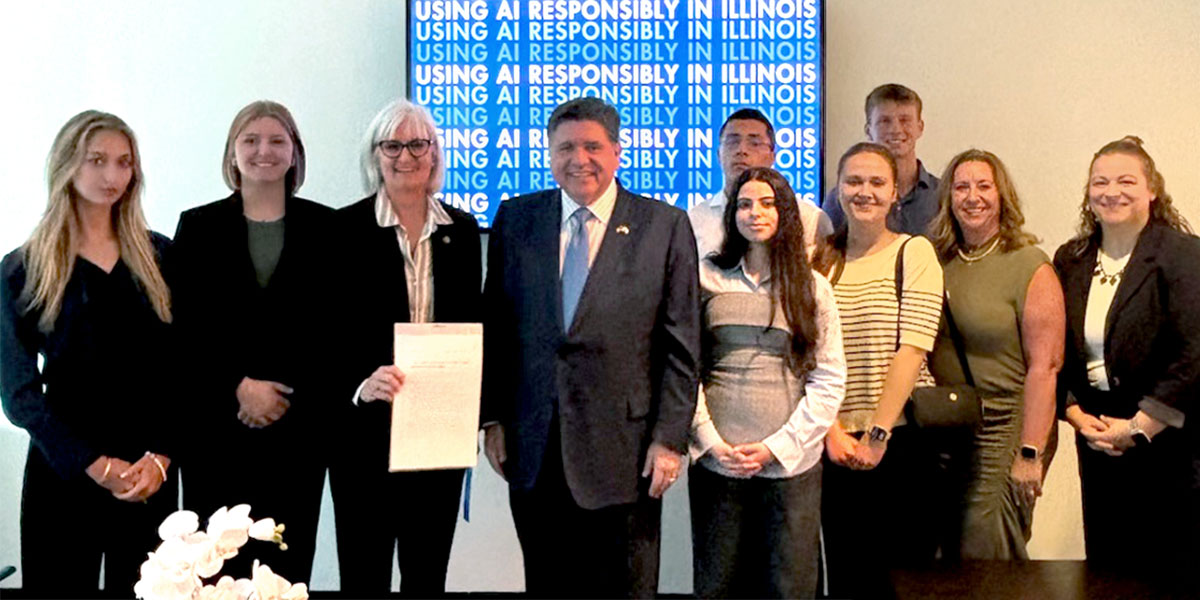
CHICAGO – Senator Mary Edly-Allen’s landmark law, the first of its kind in the country, was signed into law, aiming to establish safety standards and transparency requirements for the largest artificial intelligence (AI) developers.
“This bipartisan law is about putting responsible safeguards in place before a preventable catastrophe occurs. Illinois has an opportunity to lead the nation by setting clear expectations for transparency, accountability and public safety,” said Edly-Allen (D-Grayslake). “While artificial intelligence holds extraordinary promises from curing disease to transforming scientific research, we have a responsibility to confront the catastrophic risks associated with the systems.”
Senate Bill 315 requires large frontier AI developers, companies developing advanced models such as ChatGPT and Claude, to assess catastrophic risks, report critical safety incidents, undergo independent third-party audits and establish whistleblower protections for employees raising safety concerns.
Additionally, frontier developers will be required to report critical safety incidents to the Illinois Emergency Management Agency and the Office of the Attorney General within 72 hours or within 24 hours if the incident poses an imminent risk of death or serious physical injury. The law also will direct IEMA, in consultation with the Attorney General, to establish a reporting mechanism for both developers and members of the public.
Qualifying developers will also be required to complete annual independent audits assessing compliance with the law and publish redacted audit reports.
Lastly, Senate Bill 315 will strengthen whistleblower protections for employees who disclose information related to substantial public safety threats or violations of this measure.
“For too long, the public has had to simply trust that the most powerful AI developers are testing their systems responsibly. SB 315 replaces blind trust with verifiable disclosure,” said Steve Wimmer, Senior Technical and Policy Advisor for the Transparency Coalition. “Asking the largest frontier developers to assess catastrophic risks and report serious incidents isn't a burden on innovation; it's the baseline of accountability we already expect from every other high-impact industry.”
"SB 315 makes Illinois the first state to pair AI transparency requirements with independent verification, an important step toward the accountability this technology demands,” said Cesar Fernandez, Head of U.S. State and Local Government Relations at Anthropic. “Anthropic is proud to have been the first AI lab to support this bill, and we commend Governor Pritzker and the sponsors, Senator Mary Edly-Allen and Representative Daniel Didech, for their leadership on this critical issue."
“Power has to be matched with wisdom, transparency and responsibility,” said Edly-Allen. “This law is not about stopping innovation, but balancing the great promise of AI with its potential harms.”
Senate Bill 315 was signed Monday and goes into effect Jan. 1.