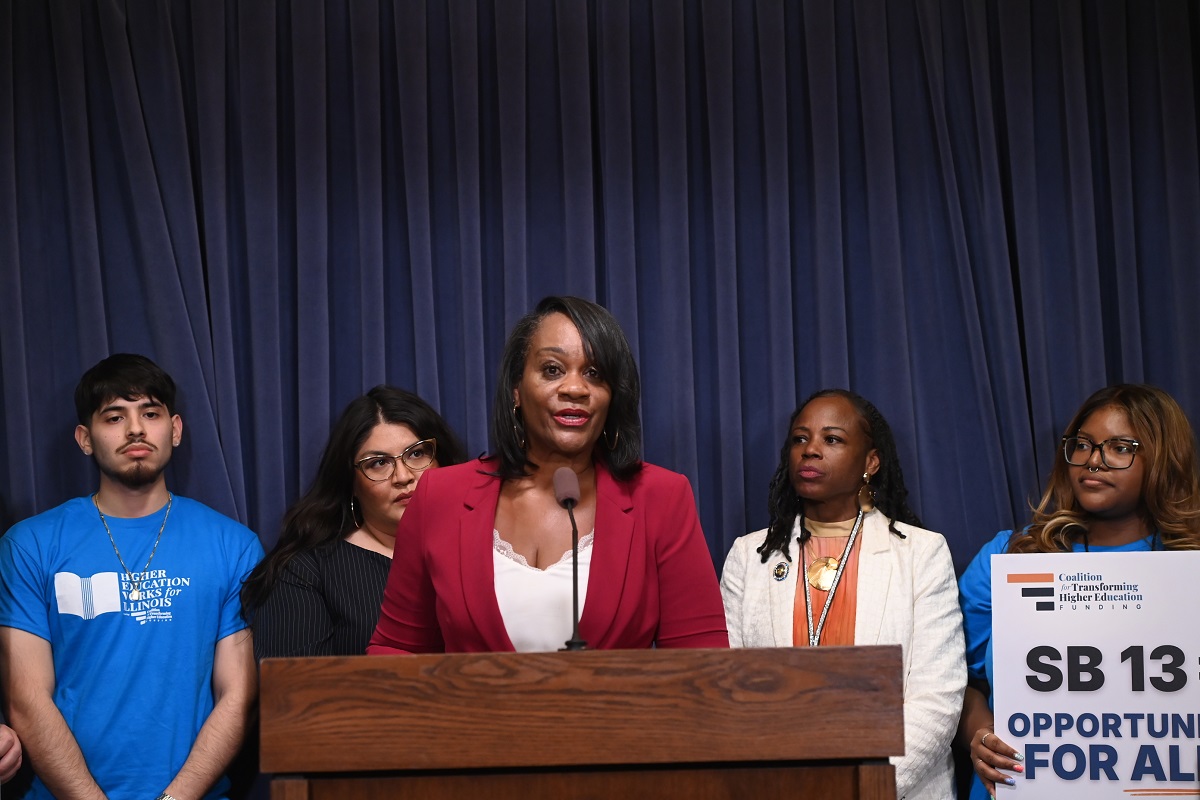
SPRINGFIELD – Senate Majority Leader Kimberly A. Lightford was joined by State Senators Mike Halpin and Graciela Guzmán, as well as a number of advocates, to fight to transform how Illinois funds its higher education system.
“Despite education’s paramount importance, the disparity in funding among higher educational institutions remains dreadfully evident,” said Lightford (D-Maywood). “This imbalance not only undermines the principle of equal opportunity but also hampers our collective progress as a society.”
Lightford was instrumental in creating the Commission on Equitable Public University Funding in 2021. Over the years, the 30-person commission studied if public institutions of higher education are in dire need of a new funding model when serving underrepresented and historically underserved student groups, including Black and Brown students, as well as students from low-income families.
The commission found on average, university systems in Illinois spend over double the amount on academic and student supports – the spending that most directly impacts student success – than at its less-resourced regional universities. Worse, these arbitrary and inequitable allocation decisions have compounded yearly due to a lack of equitable distribution.
In response, members of the Senate and House Democratic Caucus and advocates held a press conference Thursday urging the passage of Senate Bill 13 or House Bill 1581 – identical bills in their respective chambers – to implement a student-centered, adequacy-based funding formula for Illinois’ public universities known as the Adequate and Equitable Public University Funding Formula.
Combined, these variables would be used to calculate adequacy targets, or the optimal amount of annual funding each institution needs to fully serve its students.
“Our colleges and universities have been chronically underfunded for too long,” said Guzmán (D-Chicago). “This has led to cuts in the critical support services our young people need in order to learn and thrive. Illinois must focus on equity in higher education funding. We have seen huge success in the equitable funding formula for K-12, it is time we got serious about supporting our universities with the same resources.”
The measure is similar to Illinois’ evidence-based K-12 funding model, taking a parallel approach for higher education by outlining a formula that accounts not only for the size of institutions and the types of academic programs they offer, but also demographic factors such as socioeconomic, racial and geographic diversity.
“For far too long, Illinois has seen our college-aged students choose other states to further their education,” said Halpin (D-Rock Island). “By passing the Adequate and Equitable Funding formula and investing the necessary resources into the formula, we will make Illinois a more attractive option for our students as we provide them with unmatched resources and a variety of affordable options.”
Lightford, Guzmán, Halpin, university officials and advocates will fight will continue to fight to get the Adequate and Equitable Public University Funding Formula – and subsequent funding – over the finish line.